Product details description
In industries where microscopic contaminants compromise product
quality—semiconductor fabrication, aerospace, pharmaceuticals—industrial
lint-free cleaning cloths are indispensable for achieving particle-free
surfaces. Engineered to leave no fibers, residues, or particulates, these cloths
safeguard critical processes from invisible threats.
Material selection is tailored to low-lint performance. Polyester
microfiber cloths, with split fibers creating vast surface area, trap particles
without shedding. Cellulose-based wipes, made from wood pulp, are hydrophilic
and low-lint, ideal for absorbing spills without leaving residue. Blends of
polyester and cellulose combine absorbency with strength, suiting heavy-duty
cleaning. Non-woven fabrics, formed by bonding fibers thermally or chemically,
eliminate weaving-related lint, making them suitable for Class 1 cleanrooms.
Manufacturing processes minimize contamination. Closed-loop production
systems prevent airborne fibers from settling on cloths, while cleanroom
packaging (double-bagged, gamma-irradiated) ensures sterility. Fiber treatment
with antistatic agents reduces static charge, preventing particle attraction
during use. Edge sealing (laser-cut or ultrasonically bound) eliminates frayed
fibers, a common lint source in sewn cloths.
Performance metrics center on cleanliness and compatibility. Lint count,
measured by particle fallout tests (e.g., Federal Standard 209E), classifies
cloths from Class 100 to Class 100,000 cleanrooms. Absorbency (mL/m2) and
solvent compatibility (resistance to acetone, IPA, etc.) determine suitability
for diverse tasks. Low extractable levels (≤0.01% by weight) ensure no chemical
residues contaminate sensitive surfaces.
Application techniques optimize contamination control. Cloths are folded
into quarters to create multiple clean surfaces, reducing cross-contamination.
For electronics, pre-moistened cloths with deionized water or isopropyl alcohol
(IPA) remove flux residues without scratching. In aerospace, dry cloths wipe
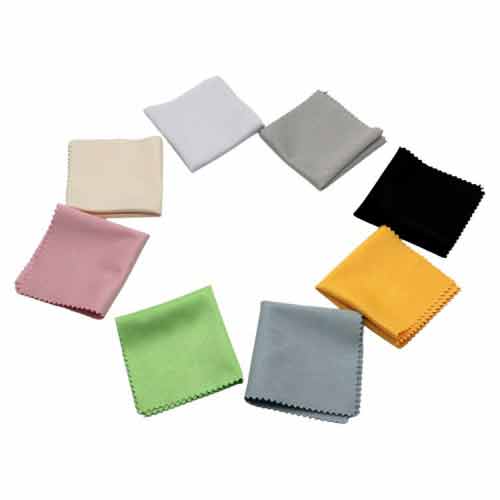
precision bearings to prevent abrasive particle ingress. Color coding (blue for
solvents, white for electronics) enforces task-specific use, avoiding
cross-contamination.
Regulatory compliance and sustainability round out their value.
FDA-approved cloths are used in pharmaceutical cleanrooms, while ISO 14644-1
standards guide cleanroom classification. Reusable cloths, laundered in
high-efficiency systems, reduce waste, and biodegradable options
(cellulose-based) minimize environmental impact. By marrying material science
with contamination control expertise, lint-free cloths enable industries to meet
stringent quality benchmarks and protect product integrity.
Previous article:
Comparing Woven vs. Knitted Lint-Free Cloths: Structural Strength Differences
Next article:
Why I Switched to Lint-Free Microfiber Cloths